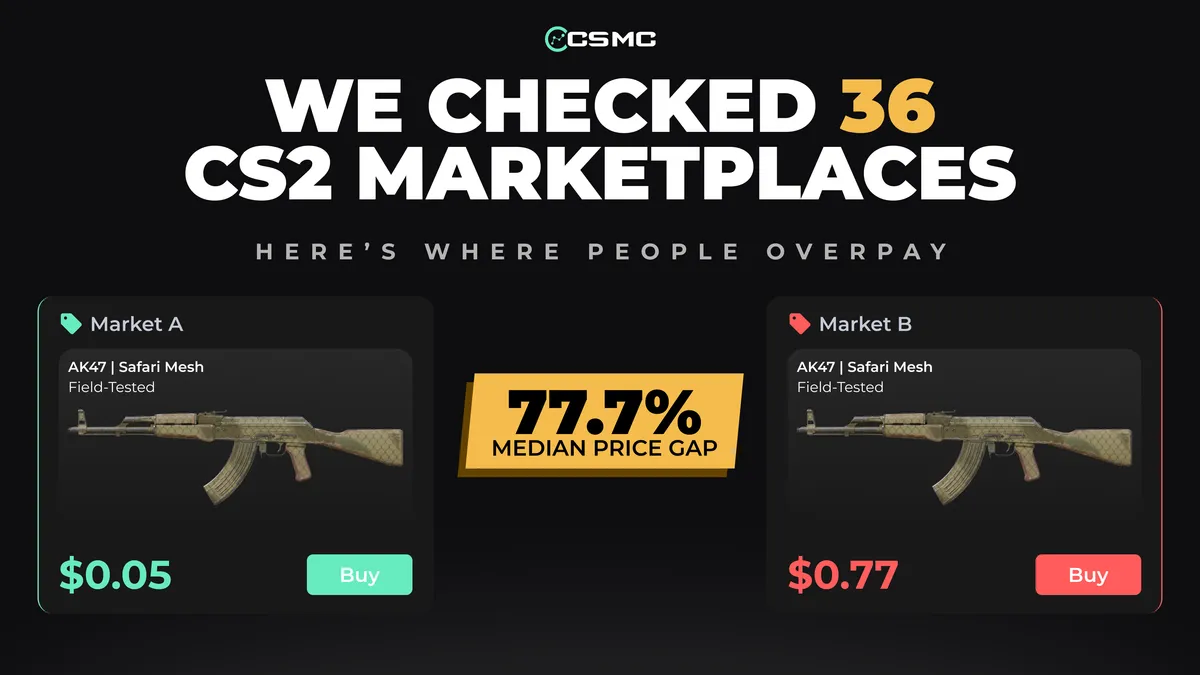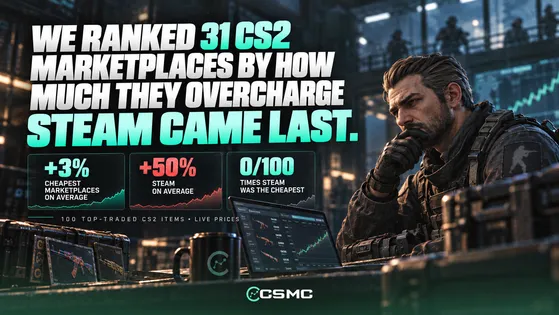
Every third-party CS2 marketplace claims to have competitive prices. We stopped taking that on faith and just checked: same 100 items, same moment in time, 36 marketplaces, nearly 2,900 individual listings. The gap between what you'd pay on the cheapest platform and what you'd pay on the priciest, for the exact same item, is larger and more consistent than it should be in a market this size.

The headline number
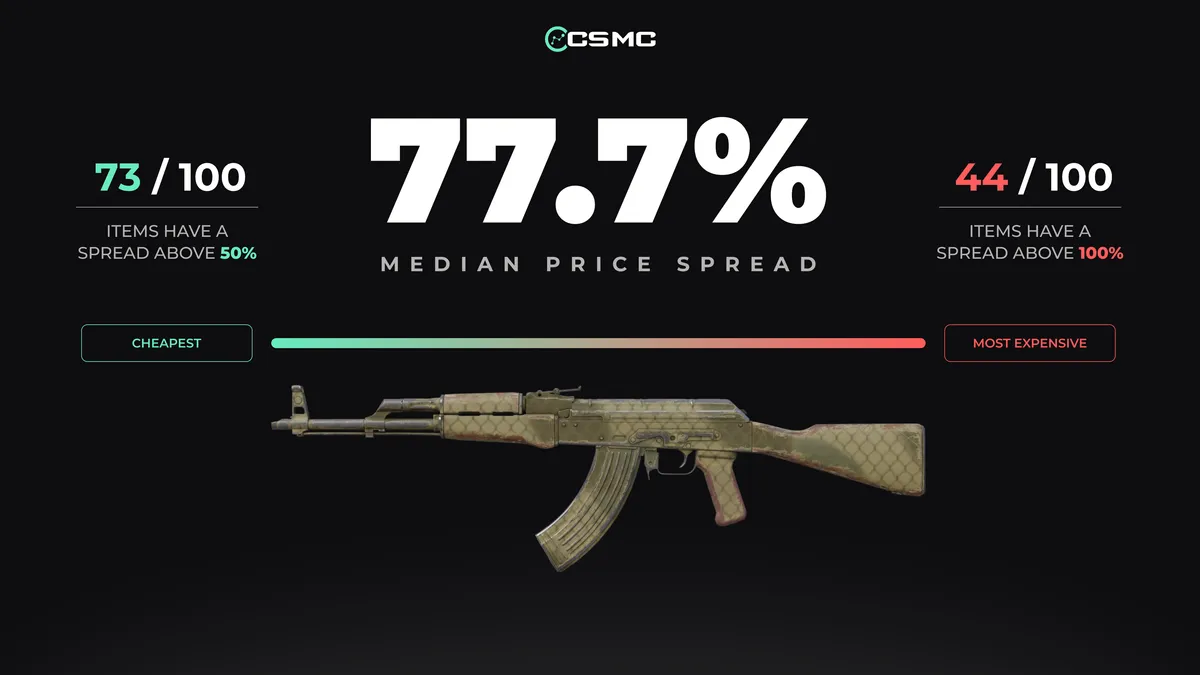
Across all 100 tracked items, the median spread between the lowest and highest listed price is 77.7%. Not the average, which gets pulled up by a handful of extreme outliers, the median, meaning half the items in our tracked set have a spread at least that wide. 73 of the 100 items have a spread above 50%. 44 have a spread above 100%, meaning the most expensive listing is more than double the cheapest.

"But those are just dead listings," and mostly, no
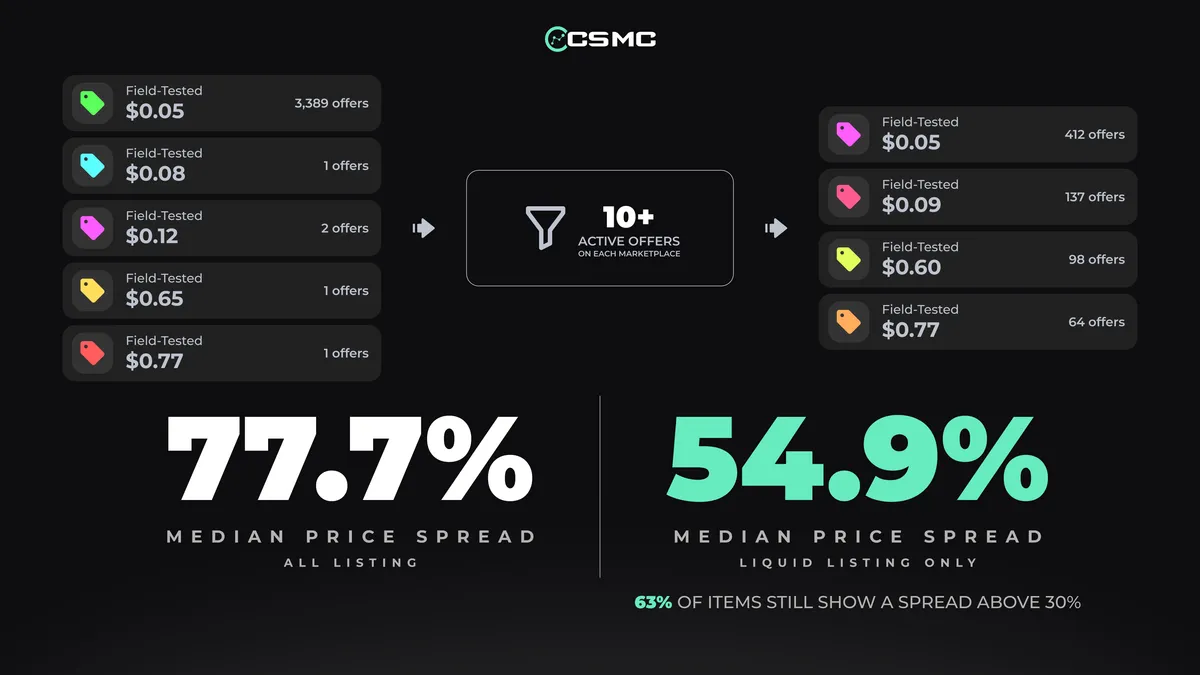
The obvious objection: a huge spread on some obscure item probably just means one market has a single stale, illiquid listing nobody's actually going to buy at. Fair point, so we re-ran the numbers filtering to only listings with at least 10 active offers on that market, cutting out the thin, one-off postings. The spread barely moves. Median spread among liquid listings only: 54.9%. 63% of items still show a spread above 30% even after removing every thin listing from the comparison. This isn't a handful of dead offers dragging up an average. It's a structural feature of how these markets price the same item independently of each other.
The worst offenders
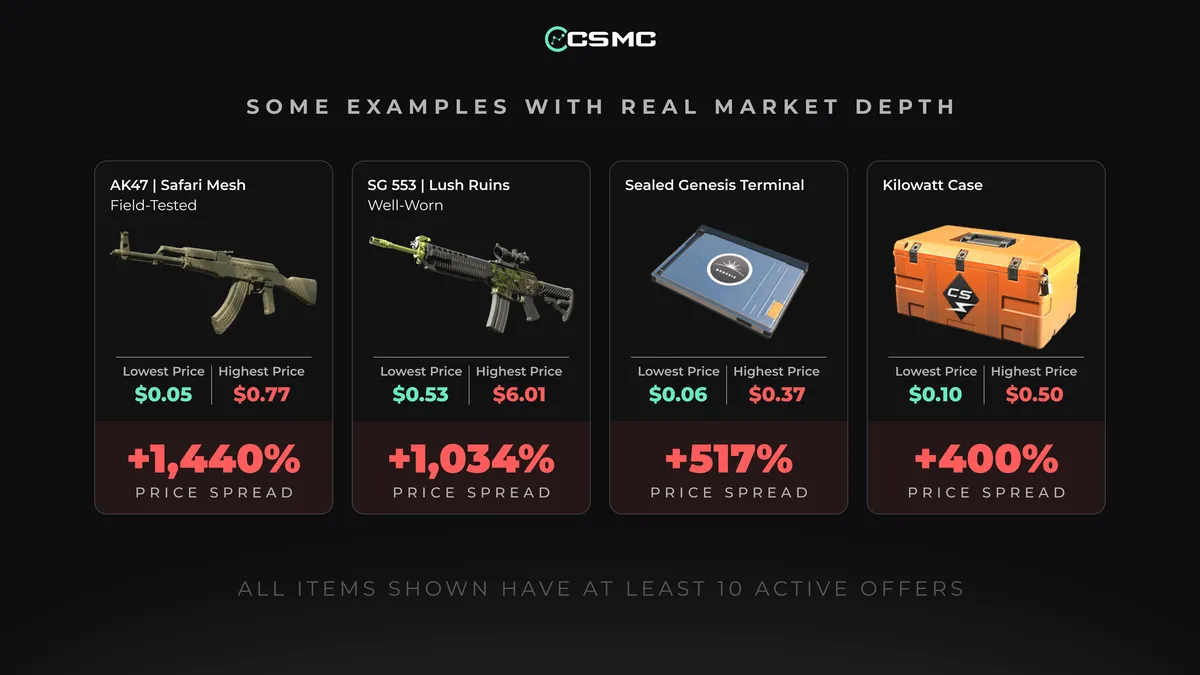
Some examples, using only listings with real depth behind them (10+ active offers):
AK-47 | Safari Mesh (Field-Tested): $0.05 on the cheapest liquid market vs. $0.77 on the priciest. A 1,440% spread on an item with 3,389 sales in the last 30 days, this is not a niche skin nobody trades.
SG 553 | Lush Ruins (Well-Worn): $0.53 vs. $6.01. A 1,034% spread.
Sealed Genesis Terminal: $0.06 vs. $0.37. A 517% spread, on a container people are actively opening right now.
Kilowatt Case: $0.10 vs. $0.50. A 400% spread on one of the three cases still in active drop.
These aren't rare collectibles where a wide spread might reflect genuine disagreement about value. They're high-volume, everyday items. The spread exists because most people check one or two markets and stop, not because the market has priced in some real difference in the item.

Where the good and bad prices tend to cluster
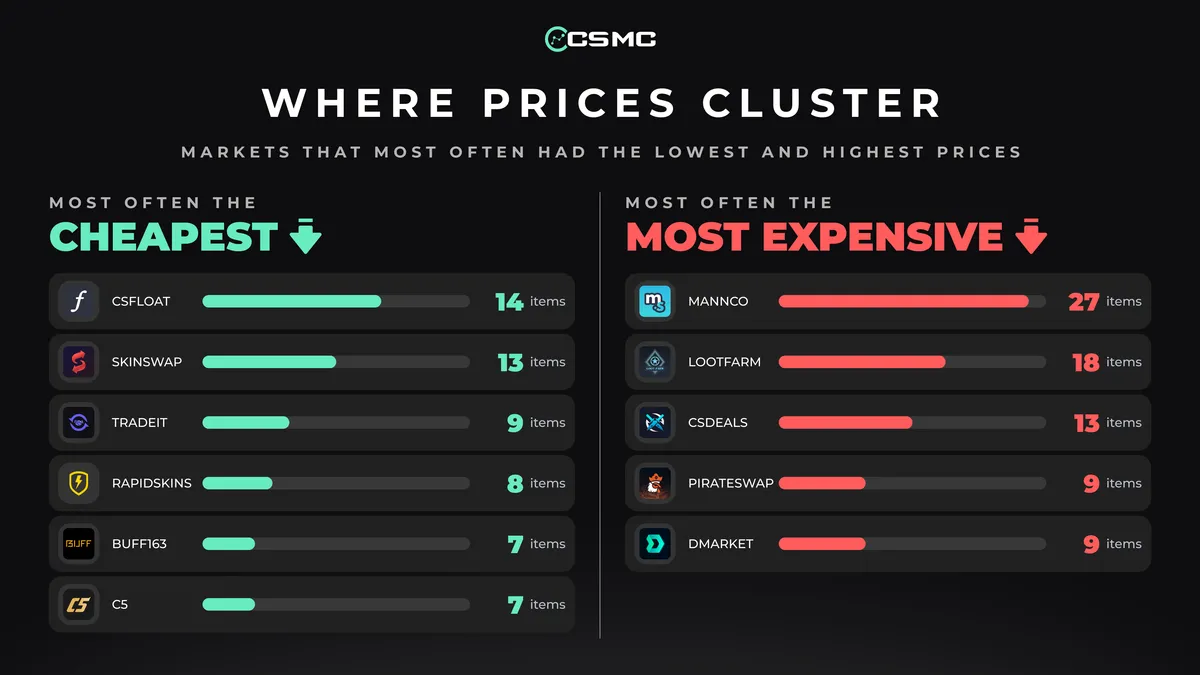
We also looked at which markets most often had the lowest price on a given item, and which most often had the highest, across the full 100-item set. Markets that showed up as the cheapest option most frequently: csfloat (14 items), skinswap (13), tradeit (9), rapidskins (8), tied with buff163 and c5 (7 each). Markets that showed up as the most expensive option most frequently: mannco (27 items, more than a quarter of the whole set), lootfarm (18), csdeals (13), pirateswap and dmarket (9 each). To be clear about what this does and doesn't mean: this is a single snapshot, not a long-run study of any market's overall pricing philosophy, and any individual market can have genuinely competitive listings on items outside our tracked set. But if you're used to defaulting to one platform out of habit, this is a reasonable prompt to at least glance at a price comparison before you buy or sell something you actually care about the price of.

Why this happens
There's no coordination between these markets, no reason their prices should converge quickly. Each one runs its own supply of listings, sets its own fee structure, and serves a partially different set of users with different regional payment options and different levels of platform trust. A market with a smaller, less price-sensitive user base can sit meaningfully overpriced for a long time without losing much business, because most of its users simply aren't checking elsewhere. That's not a scandal, it's just how fragmented markets without a shared order book behave. But it does mean the "market price" of a CS2 skin isn't really one number. It's a range, and where you land in that range depends entirely on which platform you happened to open first.

The spread isn't free money, fees eat into it
One honest caveat before anyone reads this as "just arbitrage the gap": most of these markets charge a withdrawal, deposit, or trade fee somewhere in the process, and moving an item from one platform to another to capture a price difference usually costs something in fees and time. A 78% headline spread on paper doesn't mean 78% of free profit if you're trying to actively trade the gap, some of that spread is eaten immediately by the cost of moving the item at all. What the spread does mean, reliably, is that if you're already planning to buy or sell an item you own, checking more than one market before you do costs you nothing and can save you real money. That's a very different claim from "go arbitrage this," and it's the one the data actually supports.
A second pass: does item price change the picture?
We also checked whether cheaper items have wider percentage spreads than pricier ones, since a few cents of absolute difference can look like a huge percentage on a $0.05 item. It's a real effect, several of the widest spreads in our liquid-only list are on items priced under $1, where a $0.20 absolute gap between markets is enough to show up as several hundred percent but the effect doesn't fully explain the pattern. Restricting to items with a minimum liquid price above $5 still leaves a meaningful share of the set with double-digit percentage spreads, just smaller in absolute dollar terms. The takeaway holds at every price tier we checked: cheap items show it as a dramatic percentage, expensive items show it as real money, and neither group is immune.
The takeaway
If you're buying or selling anything beyond pocket change, a quick price check across markets is worth more than it looks like it should be, on the median item in our dataset, the difference between the best and worst price is worth roughly three-quarters of the item's value. That's not a rounding error, that's the whole reason to compare before you commit.