
This doesn't look like a traditional VAC wave
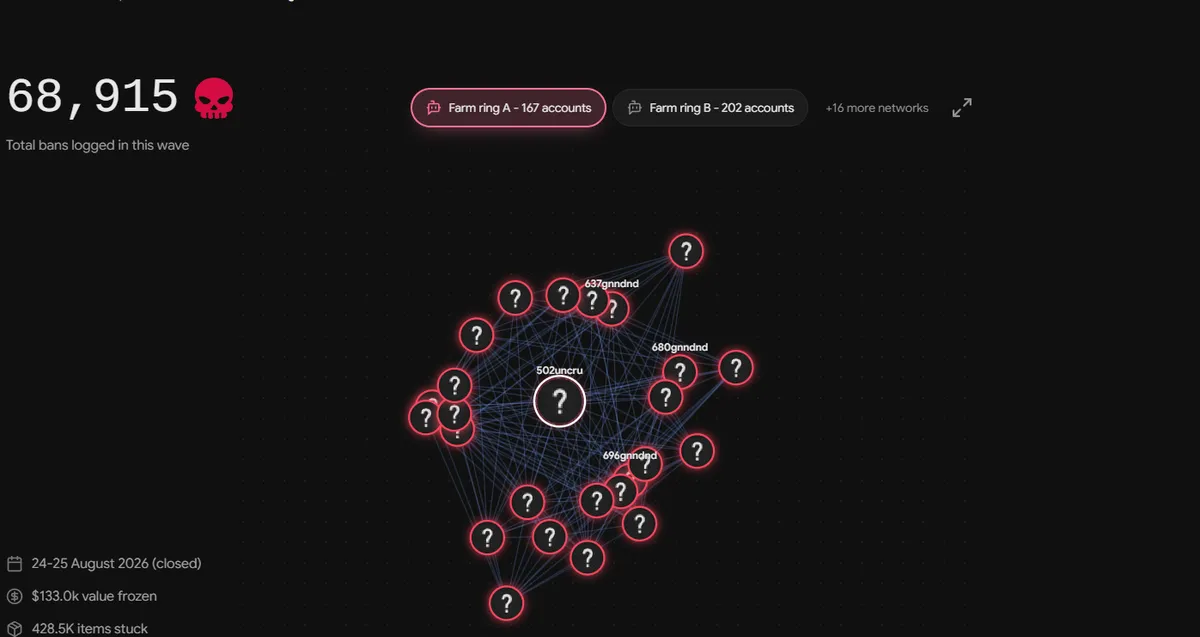
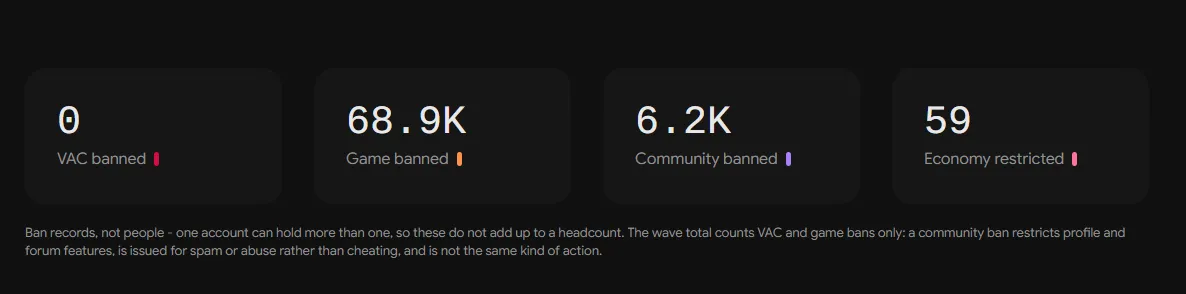
The first thing that stands out is the ban type. According to VAC-Ban.com's public Steam index, every record in the wave was a game ban. There were zero VAC bans. That's important because the community often uses “VAC wave” as a general term for any large ban event. Technically, these are different enforcement mechanisms. A VAC ban is associated with Valve Anti-Cheat. A game ban is issued at the game level and can be used for other types of enforcement. In this case, the complete absence of VAC bans makes the event look very different from a conventional cheat-detection wave and the account data makes the picture even more interesting.
80% of the accounts were created recently
VAC-Ban.com was able to retrieve account creation dates for 65,623 of the banned accounts. 52,514 were created in 2025 or 2026. That's approximately 80% of the cohort. More than 31,000 were created during 2025 alone. That's an unusual profile for a population dominated by long-term players. The tracker also found that CS2 was the most recently played game on the majority of profiles where recent activity was visible. In other words, we're not looking at a random selection of old Steam accounts. We're looking at a heavily concentrated population of relatively young accounts connected to CS2.
The farm theory
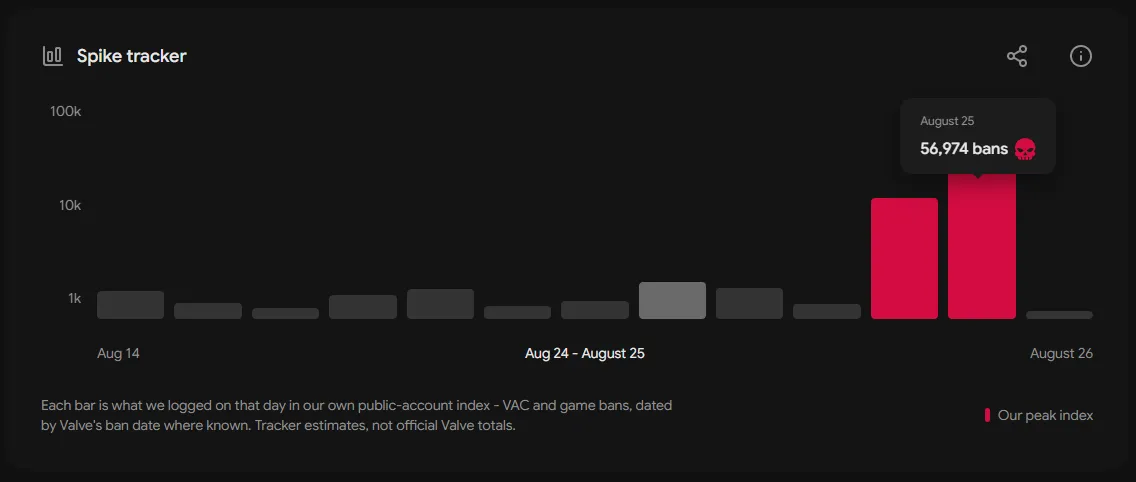
This is where the community's speculation about farming becomes interesting. The August wave arrived only weeks after another major CS2 enforcement event. On August 6, VAC-Ban.com's index recorded more than 30,000 game bans in a separate wave. The tracker found that the affected accounts were heavily associated with CS2 farming: the accounts owned CS2, had significant playtime, and showed characteristics associated with Service Medal and Armory Pass farming. The latest wave shows several similarities but there is an important distinction:
The data does not prove that every account was a farming bot.
A Steam game-ban record does not tell us which game mode caused the ban. It doesn't say “Deathmatch bot.” It doesn't say “10v10 farmer.” And it doesn't identify a particular farming operation. Those claims are circulating within the community, but they should remain claims until Valve provides more information.
The strange part: coordinated account networks
The tracker found another signal inside the latest cohort. Around 36,992 friendships connected banned accounts to other banned accounts, forming 102 identifiable rings after filtering out isolated connections. The largest network contained 202 accounts. Another dense cluster contained 167 accounts connected by more than 4,400 friendships. That doesn't automatically prove that every account in those networks belonged to the same operator but it does show that a meaningful portion of the wave was highly interconnected and that is exactly the kind of pattern you would expect to investigate when looking for coordinated account activity.
Most of the inventories were basically empty
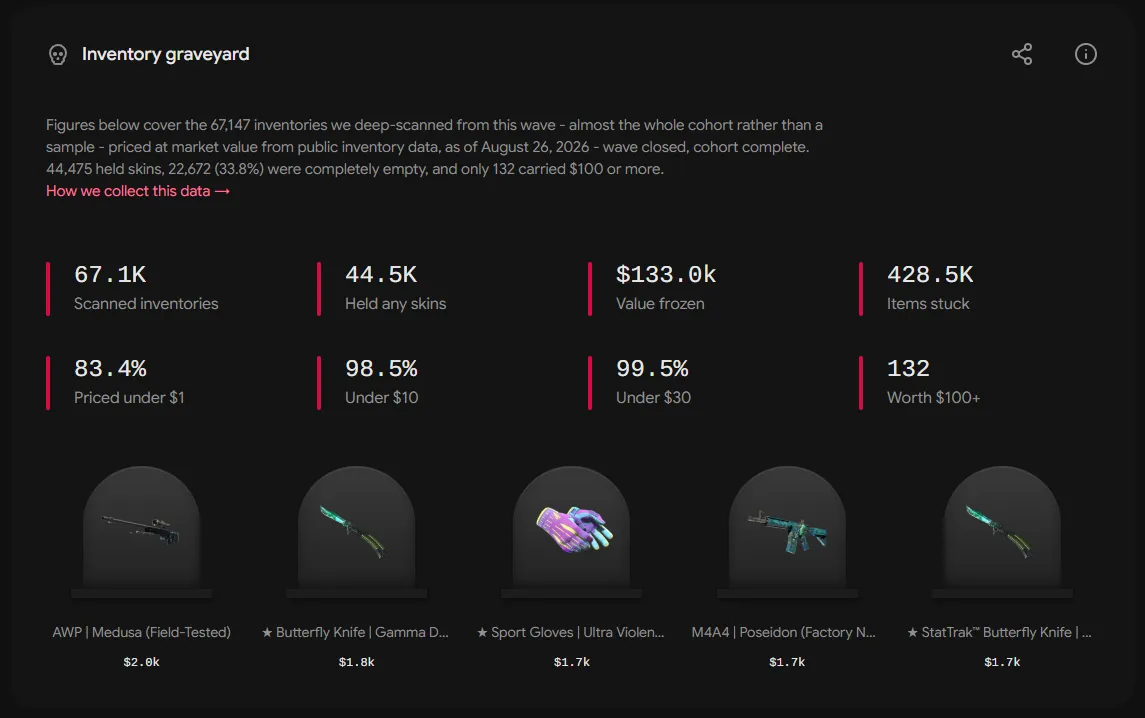
The inventory data provides another interesting clue. VAC-Ban.com scanned 67,147 inventories from the wave where Steam returned inventory data. The vast majority were extremely low value. The tracker reports that 83% of the inventories were worth less than $1. That is very different from the profile of a normal established CS2 player with a developed inventory. Some accounts did hold valuable skins, however. The largest inventory identified in the dataset was valued at almost $20,000. Once an account is banned, those items effectively become frozen inside the account. That creates an interesting side effect for the CS2 economy.
Could this affect the skin market?
Potentially. This is where a ban wave becomes more than just an anti-cheat story. Farm accounts are part of the supply chain of the CS2 economy. They generate cases. They generate drops. They generate Armory progress and eventually, those items enter marketplaces. Remove a large number of farming accounts and you potentially remove future supply. The effect won't necessarily be immediate. A banned account can already have generated thousands of items before it disappeared but if Valve continues running these operations regularly, the long-term supply curve could change. That's especially relevant for items where farming represents a significant portion of total supply.
The bigger pattern
The August 25 wave didn't happen in isolation. In March 2026, Valve confirmed a historic purge of roughly 960,000 bot accounts in a single day. Then came another large farming wave in June. A July wave followed. August brought another major purge on the 6th and now we have the August 24–25 event. The pattern is becoming difficult to ignore. Valve appears to be increasingly aggressive toward automated account ecosystems. The question is no longer whether farming is being targeted. The more interesting question is how systematic this enforcement will become.
What we still don't know
There is one thing worth emphasizing. Valve has not publicly explained this specific ban wave. That means we should be careful with conclusions. We don't know exactly how many of these accounts were farmers. We don't know which game modes were involved. We don't know whether the Patrol system played a role and we don't know whether every ban will remain permanent. VAC-Ban.com itself describes its figures as measurements from its own public Steam index rather than official Valve statistics. That distinction matters. The data is extremely useful for understanding the scale and characteristics of the event, but it shouldn't be presented as an official Valve report.
What happens next?
The next few weeks could tell us more than the ban wave itself. If farming activity drops, fewer new items could enter the economy. If Valve continues with similar waves, automated account operators may start facing a much higher cost of doing business and if the enforcement becomes regular rather than occasional, the impact could eventually appear in CS2 market data.
For now, the biggest takeaway is simple:
This wasn't just a large number on a ban tracker.
It was a massive, highly concentrated wave of game bans, dominated by young CS2 accounts, with thousands of connections between banned accounts and almost no VAC bans and if the community is right that these waves are increasingly targeting farming infrastructure, Valve may be changing the supply side of the CS2 economy one ban wave at a time.